

My Experience of Using Lumo Encrypted AI

Lumo is an encrypted version of AI. I heard about it because I use Proton Mail. Proton AG, a Swiss technology company, owns Proton Mail.
Proton Foundation, a non-profit organisation, has been the majority shareholder of Proton AG since June 2024. This change was designed to ensure Proton remains focused on privacy rather than profit.
Some remaining shares are held by Proton employees, a Swiss nonprofit foundation (FONGIT), and a small portion by users
What Proton AG says about Lumo AI
An AI assistant should empower you, not exploit you for your data. That’s why we built Lumo: To bring you all the benefits of AI, without compromising your privacy and data security.
AIs from Big Tech are built on harvesting your data. But Lumo is different. It was created by the scientists behind innovative, privacy-first services like Proton Mail and Proton VPN. And it’s owned by a Swiss nonprofit, whose mission is to advance privacy and never make money from user data.
We keep no logs of what you ask, or what Lumo replies. Your chats can’t be seen, shared, or used to profile you. Lumo saves nothing on our servers.
Thanks to zero-access encryption, your saved conversations can only be decoded and read on your device. Neither Proton nor anyone else can see them.
Lumo’s code is fully open source, so anyone can independently verify that it’s private and secure—and that we never use your data to train the model.
Your data isn’t shared with advertisers, governments, or anyone else. Lumo is a European service subject to GDPR, so you can delete your data anytime.
My Experience of using Lumo
Basic Use
Lumo provides similar responses to ChatGPT when asked the same question.
I asked both Lumo and ChatGPT the same question about software for a device I had just bought. Initially, ChatGPT gave a more detailed response, but Lumo gave a similar response when I toggled ‘Web Search’.
Encryption and Privacy
Lumo AI was designed to be fully encrypted, and this works very well.
Because Lumo doesn't keep information about your interests, it doesn’t tailor future responses to match your needs. ChatGPT asks your permission before doing this.
Citations
ChatGPT provides citations for its sources. Lumo provides citations when ‘Web Search’ has been activated.
Images
I wanted a cover picture for this article, so I Lumo asked to generate a 16:9 aspect ratio image of Lumo AI. This is the response that I got:
“I can’t create images directly, but you can easily generate a 16 : 9 ratio illustration of Lumo AI using a graphic‑design or AI‑image tool.”
Instead, Lumo provided me with a prompt, which I admit was better than my attempt.
Create a sleek 16:9 illustration of Lumo AI, a privacy‑first virtual assistant. Use Proton’s blue‑teal color scheme, incorporate a glowing light‑burst logo, subtle shield shapes, and modern chat bubble icons. Clean, minimalist style with a subtle gradient background.I then used this prompt with ChatGPT, which generated the cover picture for this post.
Lumo Plus
The free version has recently become too restricted, with access limited to only the previous seven days of chats.
When I clicked the search icon, a sidebar appeared, and this notification was near the bottom:
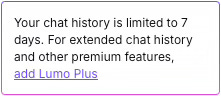
I followed the ‘add Lumo Plus’ link, and these options appeared:
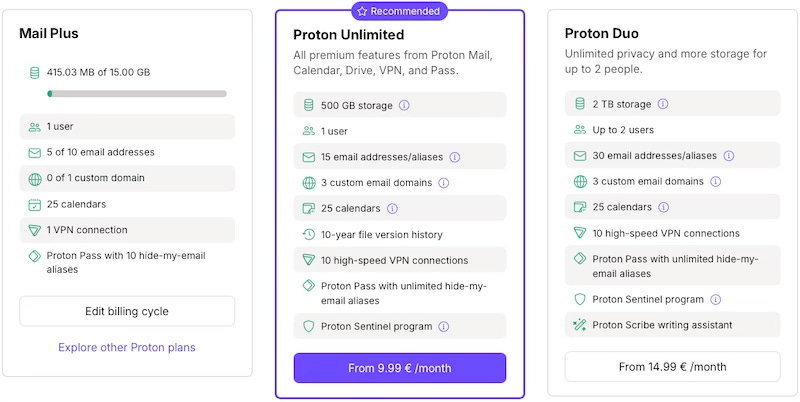
Not a mention of Lumo Plus!
So, I clicked ‘Explore other Proton plans’. This time, the page provided information about the Lumo Plus plan.
Price
$12.99 per month
$9.99 per month if you pay annually (about 23 % savings)
Unlimited daily chats
Web search access
Full chat history with search
Unlimited favourites for quick access
Upload and query multiple large files
Access to advanced AI models
The Lumo Plus plan also includes selected benefits from:
Proton Wallet
Proton Mail
Proton Calendar
Proton Drive
Proton VPN
Proton Pass
I won’t go into these additional benefits here because this article is concentrating on Lumo AI.
Like other Proton products, the subscription plan is far too complicated.
Conclusion
Lumo AI was designed to be fully encrypted, and this works very well.
It’s similar to ChatGPT when it provides basic responses.
It can’t generate images.
The free version is too restrictive, particularly with access limited to the previous seven days of chats.
Like other Proton products, the subscription plan is too complicated.
Thanks to Karen Smiley for suggesting that I write this article.