

Stop Your Plans from Failing
Save them with contingency planning


When you first make a plan, you ‘plan for success’ — that is, you assume that everything will go right and the outcomes will be just as expected. Of course, the real world has a habit of challenging the best-laid plans, and whatever could go wrong often does — at the worst possible time. It is for this reason that contingency planning should be an element of every plan.
A contingency is an event which may or may not occur. Contingency plans are alternative courses of action to take if the planned actions are disrupted or become inappropriate.
Identifying the contingencies
Perhaps, the hardest part of contingency planning is identifying what could go wrong. Failure to identify potential problems is often a failure of imagination.
Experience will tell you the kind of things that could go wrong, and disasters sometimes give you warnings in the form of ‘close shaves’.
When you have identified as many potential problems as you can through experience and intuition, look at each planned activity in turn and determine what would be the effect if the activity:
doesn’t happen,
happens too late,
happens too early,
requirements under-met,
requirements over-met.
It is unlikely that you will identify all possible failures, but the exercise is still worth doing because if you have plans in place to deal with the problems you can imagine, you will have more time to deal with those you didn’t.
In fact, it’s a good idea to put a little extra time and resources into the project to deal with these unexpected contingencies.
Analysing the contingencies
Analysing the contingencies is also called risk assessment. The action you would take for a particular contingency will depend on two factors:
Probability
Impact
For example, if there is a negligible chance that the problem will occur (low probability) and the consequence would have a very low impact, then it would be safe to ignore this particular problem and take no action.
“Probability is about expectation; impact is about regret.”
Probability
For each of the potential failures, you should establish the probability of occurrence. In other words, what is the chance of the unwanted event happening? When throwing dice, there is a one-in-six chance of throwing a six.
Probabilities are frequently expressed as decimals. So, a one-in-six chance is a 0.167 probability. If an event is certain to occur, its probability is 1. If the event is impossible, its probability is 0.
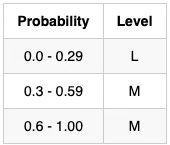
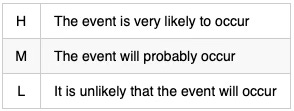
When carrying out simple risk assessments, rather than using precise figures, it is usually sufficient to rate the probability of the event happening as 'H' high, 'M' medium or 'L' low.
Impact
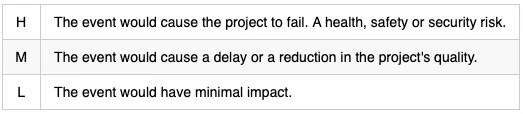
Impact considers the seriousness of what would happen should the failure occur. For example, if a nuclear power plant were to leak radioactive material, the impact would be extremely high.
Using numbers, the lowest is 0, and the highest is 10.
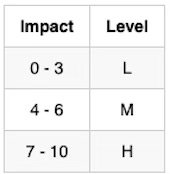
As with the probability assessment, it is usual to use ‘H’, ‘M’ or ‘L’ with impact:
Action planning
There are two main categories of action you can take when planning for contingency:
Prevention
Contingency
Prevention
This will reduce the probability of the event occurring and consists of actions inserted into the original plan before the activity where the unwanted event might occur. For example, if you might run out of fuel, you could plan to carry a spare can.
Contingency
Contingency actions are those you plan to take if unwanted events do occur. They are used when it is not possible to prevent the occurrence and are actions that are designed to either correct the problem or reduce the damage.
In addition to taking a predefined action (sometimes known as ‘Plan B’), you can also allocate additional time or resources.
Trigger events and contingency actions should be included in the original plan.
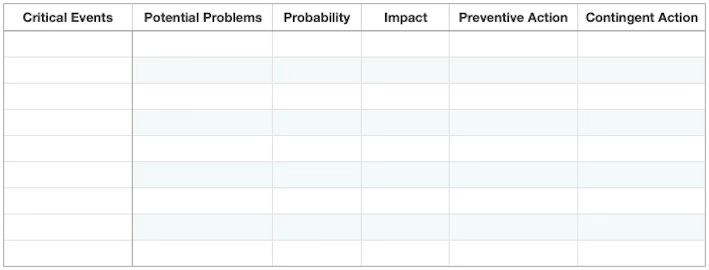
Now you are in a position to identify the critical events in the plan - usually events which have a high probability or impact.
For each of the critical events, list the potential problems and rate them for probability and impact.
A spreadsheet is recommended for entering this data.
Members can download a spreadsheet template from the Spreadsheets Section of the Learning Pages Digital Vault.
Whether you take any action, and the type of action you take, will depend on your assessment of these ratings. There is no substitute for good judgment of a particular situation, but the following guidelines may help:
If possible, prevent the problem rather than minimise or correct it.
Unless you are absolutely confident that the probability of an occurrence is zero, always consider high-impact problems as critical.
Medium-impact problems should at least have a planned contingency action.
High-probability events are not always critical if the impact is very low.
The following table provides a guide for assessing the risks based on probability and impact. It also suggests possible actions based on the risk assessment.
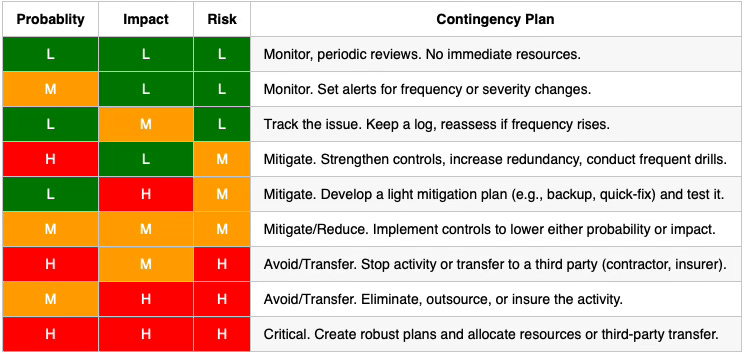
Members can download a Python script from the Programs Section of the Learning Pages Digital Vault. This script takes L, M and H probability and impact inputs and outputs possible contingency plans.
Summary
Identify the critical parts of the plan, particularly regarding the availability of essential resources such as key items of information or specialist team members.
Identify the risks which could affect the plan at each critical point.
Rate each in terms of probability of occurrence and impact (’H’ for high, ‘L’ for low).
Focus on the most important risks (i.e. those with high probability and high impact) and specify what actions to take to prevent their occurrence. Build these actions into your plan.
Identify what corrective or minimising action could be taken if, despite your preventive action, it were to occur.
Note the monitoring method you will use to trigger the actions within your contingency plan. Build the monitoring action into your plan.
Next steps
A more accurate report can be generated by using 0.0-1.0 for probability and 1-10 for impact.
Risk = Probability x Impact
In some cases, this risk score will be the same for 2 different combinations (e.g. H-L and L-H). In these situations, it might be worthwhile to focus more on events where the impact falls into the H range.
Associate Members can request modifications to the Python script to take account of the above and other factors.
I appreciate you taking the time to break these steps down.