

The Moon and its Phases


The Moon must have made an incredible impression on the first members of the human race. It was the brightest object in the night sky, constantly and regularly changing shape.
The impression that the moon had on our ancestors may have led to the invention of the first calendars. What could be more natural than saying, “Let’s meet again at the next full Moon.”
The Moon’s phases were visible to everyone, and their use would avoid the counting and recording of the number of days since the last meeting.
It was inevitable that the month would become an inseparable part of our calendar — along with the day — marked by the movement of the Sun — and the year, which was marked by the passing of the seasons.
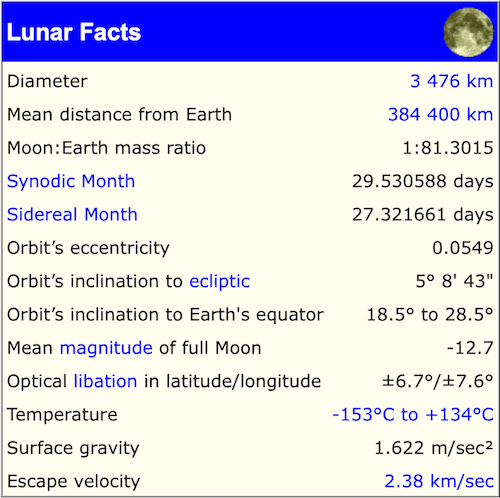
Synodic Month
The synodic month (or lunation) is the average period of the Moon’s orbit with respect to the line joining the Sun and Earth.
Sidereal Month
The sidereal month is the time it takes the Moon to return to a similar position among the stars.
Ecliptic
The ecliptic is an imaginary circle in the sky that represents the apparent path of the Sun across the celestial sphere over the course of a year, as viewed from Earth.
Magnitude
An object with a magnitude of 1 is considered to be very bright. It is about 2.512 times brighter than an object with a magnitude of 2. The Sun’s magnitude is approximately -26.74 in the visible band of light.
Optical Libration
Optical Libration is a phenomenon that occurs in the Moon's motion as seen from Earth. It refers to the apparent rocking or oscillation of the Moon’s surface back and forth in an east-west /north-south direction.
How many Lunar Months are there in a Year?
A natural next step would have been to link the lunar month with the year. This is where the difficulties began.
Twelve lunar months, with four seasons of three lunar months, seems a good approximation to the year. Unfortunately, the lunar month is just over 29½ days long, which means that twelve lunar months fall short of a year by about eleven days.
Starting a year eleven days early might not seem much, but after only three years, the lunar year would be a calendar month out of step with the seasons, which would certainly cause problems with the sowing of crops if you live in an agricultural community.
So, how about a year of 13 lunar months? Unfortunately, this results in a year that would be over 18 days too long.
The Metonic Cycle
In 433 B.C. Meton discovered that 19 years, or 6939.689 days, is almost precisely the same length as 235 lunar months, which is 6939.602 days. This produces a 19-year cycle comprising 12 years of 12 lunar months and 7 years of 13 lunar months. This keeps the lunar months in step with the seasons. These dates were inscribed in gold lettering on public monuments. For this reason, the number of years in a Metonic Cycle is called the Golden Number.
The first year of a cycle can be chosen arbitrarily, but the cycles now in use can be traced back to 1 BC, where the cycle begins at 1 when the New Moon occurs on 1 January (1995, 2014, 2033). You can also see whether a year is the beginning of a cycle by dividing it by 19 and checking whether the remainder is 0.
The Hebrew Calendar
In Israel, the Hebrew Calendar is used for religious purposes. It provides a time frame for agriculture and is an official calendar for civil holidays, alongside the Gregorian Calendar.
Like the modern Islamic calendar, the timing of the months in the early forms of the Hebrew calendar depended on actual sightings of the Crescent Moon.
However, this practice was gradually changed, and by 1178 AD, the calculation of the beginning of a new calendar month had been fully replaced by a mathematical approximation.
The Hebrew lunar year is about 11 days shorter than the solar year and uses the 19-year Metonic Cycle (see below) to bring it into line with the solar year. Even with this correction, the average Hebrew Calendar year is about 6 minutes and 40 seconds longer than the Gregorian calendar. This means that every 216 years, the Hebrew calendar will fall a day behind the Gregorian calendar.
The Islamic Calendar
The Muslim calendar uses a system based on lunar months with alternating months of 29 and 30 days. This means that all the months, including the ninth month of Ramadan — the month of fasting — continually cycle through the seasons.
To keep the months in step with the Moon’s phases, a further correction is made by varying the length of the twelfth month over a 30-year cycle: 29 days long for 19 of the years and 30 days long for the remaining 11 years.
Predicting the Phases of the Moon
Calculating the date of many religious festivals, including Easter, requires you to be able to predict the dates of the full Moon.
As the mean time between the Moon’s phases is just over 29½ days, you could roughly predict the next few occurrences of the same phase by alternating gaps of 29 and 30 days.
Unfortunately, this method will become inaccurate after a few months because the Moon is subject to over 1500 influences, which can affect the date of the full Moon from month to month.
You could also use a more accurate figure, such as the Synodic Mean (29.530558 days), for the lunar month.
The Metonic cycle described above is more accurate, and the table shown below gives you the dates of the full Moon for 2014–2051 with the Golden Number for each of those years.
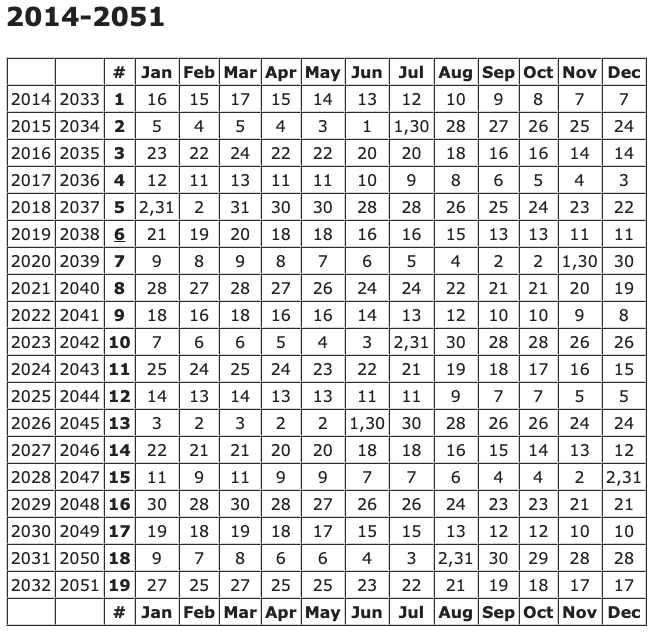
Using the Metonic Cycle doesn’t always give the correct date for the full moon, so I’ve created a Python script that provides more accurate dates.
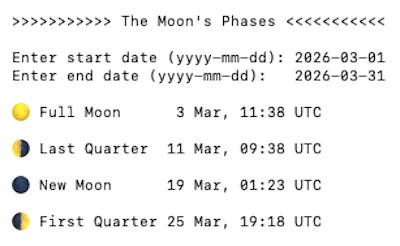
Paid subscribers can download this script from the Programs section of the Learning Pages Digital Vault.